
How to Choose Portable Power: Chargers, Power Banks & What Actually Matters
A technical decision guide on USB-PD standards, GaN semiconductor efficiency, true power delivery profiles, and battery capacity trade-offs.
Understanding the Category
Modern USB-C hardware promises universal charging, but mismatched protocols, deceptive wattage marketing, and thermal constraints often lead to buyer regret.
Choosing between a wall charger and a power bank — or selecting the right output wattage — is rarely as simple as buying the largest number on the box.
Charging speed is limited by the lowest common denominator between the power source, the cable, and the device's internal power management controller.
This guide outlines the technical factors that dictate actual charging performance, device safety, and portability.
Who This Guide is For
- ✓Laptop and MacBook users needing reliable 45W–100W Power Delivery on the go
- ✓Frequent commuters and business travelers carrying multiple USB-C devices
- ✓Buyers frustrated by slow charging or bulky OEM charging bricks
- ✓Anyone trying to consolidate their desk and travel setups to a single charger
What Actually Matters
Key technical factors that dictate actual performance and longevity.
Gallium Nitride (GaN) vs. Silicon Architecture
GaN semiconductors operate at higher voltages and switch power faster with less heat generation than traditional silicon. This allows manufacturers to shrink charger footprints by up to 50% while maintaining 65W–100W outputs.
Power Delivery (USB-PD 3.0 / PPS) Profiles
High wattage alone does not guarantee fast charging. Modern smartphones (like Samsung and Pixel) and tablets require Programmable Power Supply (PPS) to dynamically adjust voltage in real time. Without PPS, a 100W charger may drop back to standard 15W–18W speeds.
Rated Capacity vs. Usable Energy in Power Banks
A 20,000 mAh battery cell rated at 3.7V holds roughly 74 Watt-hours (Wh) of potential energy. Because DC-to-DC conversion to 5V, 9V, or 20V introduces heat and conversion inefficiency (typically 15–25%), the real-world delivered capacity is usually 14,000–16,000 mAh.
Dynamic Port Splitting & Multi-Device Throttling
When a multi-port charger advertises 100W, that rating is almost always for a single port in use. Plugging in a second or third device triggers internal power reallocation, often dropping the primary port to 45W or 65W.
Common Trade-offs to Consider
No product is universally perfect. Every architectural decision incurs trade-offs.
✕High Capacity vs. Weight & Airline Regulations
A 20,000 mAh power bank offers multiple laptop recharges but weighs 350g–500g. International aviation regulations (FAA/DGCA) prohibit power banks exceeding 100Wh (approx. 27,000 mAh) without airline approval.
✕Multi-Port Versatility vs. Full Single-Device Throughput
Adding secondary USB-A and USB-C ports introduces internal power negotiation chips that briefly disconnect active devices when a new cable is plugged in.
✕Ultra-Compact Footprint vs. Sustained Thermal Dissipation
Smaller GaN chargers warm up significantly during continuous high-load sessions (e.g., charging a demanding laptop from 0% to 100%). Quality thermal dissipation materials are required to avoid automatic wattage throttling.
Compatibility Considerations
- 🔍Laptops: Most modern ultrabooks require a minimum of 45W to charge while in active use; 65W is recommended for simultaneous operation and battery recovery.
- 🔍Cables: Standard USB-C to USB-C cables are limited to 60W (3A). For 65W–100W speeds, an E-Marker certified 100W (5A) cable is strictly required.
- 🔍Pass-Through Charging: Ensure the power bank supports pass-through charging if you intend to recharge the battery and your phone simultaneously overnight.
Products Researched by SmartChoice
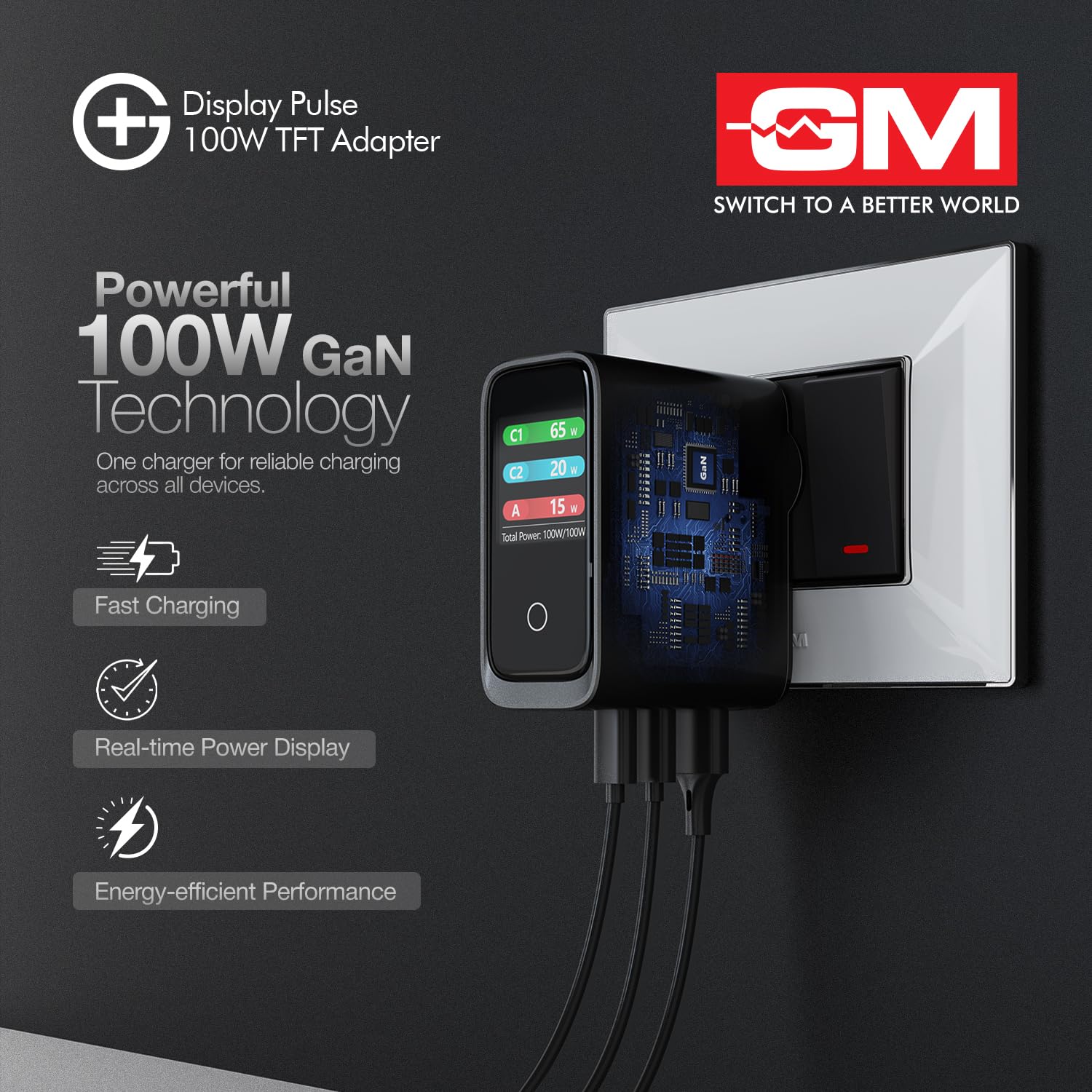
GM G+ DisplayPulse 100W GaN Fast Charger | TFT Display 14 Smiley Animation Styles | Type-C + USB-A Ports| Displays Dynamic Wattage | Best for Tablet, MacBook Air-M4, Laptop, iPhone, Samsung, DSLR
We have all experienced this specific flavor of modern irritation: you plug in your expensive smartphone or laptop, walk away for an hour, and return to find it has barely charged. The frustration of faulty cables or secretly underpowered bricks is real. The GM G+ DisplayPulse 100W GaN Charger steps in to eliminate this friction entirely with a brilliant, albeit nerdy, addition: a live TFT display. It does not just promise fast charging; it proves it by showing you the exact wattage being delivered in real-time. For anyone who has ever doubted whether their setup is actually working, this immediate visual feedback is deeply satisfying and cuts right through standard marketing fluff. In day-to-day use, this GaN brick punches well above its weight. It efficiently condenses a laptop charger, a phone charger, and an accessory brick (like earbuds) into a single wall plug. Because it uses modern Gallium Nitride (GaN) technology, it keeps heat to a minimum despite the hefty 100W output. However, you are packing a lot of tech into one housing; it is a relatively chunky block to hang directly off a wall socket, so if your outlet's grip is loose, it might feel a bit front-heavy. And while the core utility of seeing the dynamic power distribution is excellent, the rotating digital "smiley faces" on the screen border on slightly cheesy. Finally, to ensure this is an anti-regret purchase, we need to be totally transparent about the "100W" claim. This is a shared total output. The moment you plug a smartphone into port two while your MacBook is in port one, the charger physically renegotiates the power output, dropping the laptop's wattage to accommodate the phone. It is standard physics for multi-chargers, but it catches casual buyers off guard. At ₹3,399, it is undeniably a premium accessory. Yet, if you are tired of carrying three separate bricks and value the sheer peace of mind that comes from actually seeing your charging speeds, it is a highly compelling addition to your everyday carry.

URBN 20000mAh 65W Ultra Volt Power Bank
Let’s face it, low battery anxiety is a genuine modern-day friction point, especially when you're working remotely, traveling, or bouncing between meetings. Most standard power banks are just glorified phone life-support systems. The URBN 65W Ultra Volt, however, is a different beast. With a hefty 65W Power Delivery output, this isn't just about keeping your phone alive; it’s about actually delivering enough wattage to keep your MacBook Air or heavy-duty tablet running during a cross-country flight. It takes away that sinking feeling of watching your screen dim in the middle of an important task. Day-to-day usability is where this device proves its worth. The digital LED display is a massive quality-of-life upgrade—no more deciphering a vague four-dot indicator to guess if you have 25% or 5% juice left. The inclusion of pass-through charging is another lifesaver in hotel rooms or airports with limited outlets, letting you charge the bank and your phone overnight on a single plug. But we need to be transparent about the physical reality. Packing 20,000 mAh of capacity into any device means you are carrying a literal brick. It's heavy, and you will feel it in your bag. Furthermore, to actually utilize the "two-way fast charge" to refill this massive battery efficiently, you absolutely must use a high-wattage wall adapter. Try charging this with an old 5W or 10W phone brick, and you'll be waiting a full day. It's a solid investment, but one that genuinely buys you absolute, off-grid peace of mind.

Samsung Original Type C to C Cable - 3.28 Feet (1 Meter)
Let’s be real—buying a charging cable is an annoyance, not a luxury. You're probably here because your cat chewed your original cord or it mysteriously vanished at an airport. The Samsung Original Type-C to Type-C cable exists to solve that exact, irritating problem without making you overthink it. It is exactly what it says on the tin: a basic black cable that promises to properly charge your Galaxy device without the dreaded "slow charging" warning. Day-to-day usability is a mix of reliable performance and slight physical limitations. On the power front, it delivers exactly the stable current you expect from a brand-name cable, saving you from the overheating risks of cheap gas station alternatives. However, the 3.28-foot length is a genuine friction point. Unless your wall outlet is practically touching your workspace or bed, you will be doing that awkward lean to check your phone while it is tethered to the wall. Build-wise, it is standard Samsung fare. It lacks the rugged, anti-tangle rigidity of a modern braided nylon cord, meaning if you continuously bend it at a sharp angle near the connector neck, it will eventually fray just like your last one did. It is a calculated, low-risk purchase. You aren't buying it for heirloom durability; you're buying it because you need reliable, safe power right now, and this delivers exactly that.
Compare These Models Head-to-Head
Evaluate Anti-Regret matrix assessments, power profiles, and physical dimensions side-by-side without declared winners.
Practical Pre-Purchase Checklist
Verify these items before finalizing your purchase on Amazon.
Frequently Asked Questions
Can a 100W charger damage a device that only requires 20W?
No. USB Power Delivery operates through smart two-way negotiation. The charger communicates available voltage/amperage profiles, and the receiving device pulls only the specific wattage its battery management system requests.
Why does my 20,000 mAh power bank not give four full charges to a 5,000 mAh phone?
Power bank internal cells operate at 3.7V, whereas charging occurs at 5V, 9V, or higher. Voltage step-up conversion, cable resistance, and phone thermal management cause standard energy losses of 15–25%.
Does GaN technology make charging faster than traditional silicon?
GaN itself does not increase the top charging speed; rather, it increases energy efficiency and thermal dissipation. This allows manufacturers to build significantly smaller, lighter chargers that can sustain high outputs without overheating.